Category: Gear Talk For Guitarists

Guitar accessories, amplifiers, pedals, cables, guitar straps, recording equipment and software…the equipment that helps make it rock is here.

  • Great Gifts For Guitar People!

    Great Gifts For Guitar People!

    Don’t know what to pick for that picker? Well, here’s a list of…

    Great Gifts for Guitar People!

    Under $10.00

    guitar strings
    string winders
    picks
    blank manuscript paper
    guitar magazines
    guitar polish
    lottery tickets
    9-volt batteries
    a set of precision screwdrivers
    wire cutters
    a hamburger AND fries, maybe a soft drink too
    CASH!
    a couple of Red Stripes on the beach in Ocho Rios…

    Under $30.00

    a nice guitar slide
    cool music posters
    portable USB storage drives
    funky fabric guitar straps
    patch cables and short jumpers
    microphone cables
    CASH!
    a subscription to their favourite guitar magazine
    guitar tablature books featuring their favourite musicians
    music CDs
    music theory texts
    music stands
    music stand lights
    guitar stands
    more lottery tickets
    a cab from Montego Bay airport to Negril beach…

    Under $50.00

    funky leather guitar straps
    soft “gig bag” cases
    “how-to” and coffee table style guitar books
    Shubb or Kyser capos
    cheap electronic tuners
    fancy patch cables
    AC adapters
    microphone stands
    CASH!
    instructional videos & DVDs
    a case of 24 Red Stripe(!)
    cabfare from Montego Bay to Port Antonio…(maybe)

    Under $100.00

    a gig in a local club
    CASH!
    cheap effects pedals
    a guitar set-up and inspection from a local shop
    better electronic tuners
    CD box-sets by their favourite artists
    hard-shell guitar cases
    portable CD/MP3 players
    new preamp tubes for their amplifier
    very small practice amps
    concert tickets
    a day’s worth of groceries (maybe)
    headphones
    a day trip to the Bob Marley Museum…

    $240.00

    A 10 Lesson Gift Certificate for Lessons With Matthew Woodward(!) Here’s a link to The Best Gift Ever!

    Under $300.00

    new tubes for a full-size amplifier
    replacement guitar pickups
    a pickup installed into their acoustic guitar
    better effects pedals
    good quality microphones
    better small amps
    entry-level acoustic guitars
    rehearsal space rent
    CASH!
    portable CD/MP3 players
    CD/DVD burners
    fast hard drives and storage disks
    decent computer sound cards
    entry-level digital recording software
    USB recording interfaces
    a week’s worth of groceries
    accommodations in an inexpensive guest house in Port Antonio for a week…

    $300.00 to $999.99

    better quality, semi-pro acoustic/electric guitars
    flight cases
    promo shoot with a good photographer
    good amps
    portable multi-track recorders for the songwriters out there
    CASH!
    good stereo systems
    good recording computer interfaces
    multi-effects units
    nice drum software
    better yet – a half-decent set of drums
    pro-level digital recording software
    recording studio time
    return airfare to Jamaica…

    $1000.00 to $?????.??

    real nice acoustic/electric guitars
    real nice “boutique” tube amplifiers
    great home recording equipment
    real nice cars & trucks
    many beers
    rehab (No…no, no!)
    awesome drums
    a fully-equipped, state-of-the-art recording studio
    a cool van for the band to tour around in
    an extremely fast computer
    good management and a publicist
    a hit record
    CASH!
    a scenic piece of beach-front property and a nice little house in Jamaica…

    HAPPY SHOPPING!!!!

    If you enjoyed this post, please share it with others using the social media links below. I won’t mind one bit. I only ask that you respect my personally-created, copyrighted material by mentioning where you got it from. 🙂

    Your comments, corrections or suggestions for future posts are also ALWAYS most welcome.

     © 2023 Matthew Woodward
  • Notes On Tuning

    Notes On Tuning

    Although your guitar can be in tune with itself, to be in tune with the rest of the world we must have a standard reference pitch with which we can make sure that at least one of our strings is in tune. Once one string is in tune, the tuning of the others can be derived from it.

    tuning fork
    Tuning Fork

    In the not-so-distant past folks would have to tune their guitars by ear to what they thought was right, to the nearest available piano, or to any other instrument that was considered reliable. Another method employed was to tune a string by comparing its pitch to a note produced by a tuning fork, which produces its sound when it is struck against your knee or heel and is then held by its stem against the guitar. You compare the sound of the string you wish to tune to the pitch of the tuning fork and try to match it exactly by ear.

    pitchpipe
    Pitch Pipe

    The first tuning device I used was a pitch pipe (sort of a six-note harmonica). The six pipes play the notes E, A, D, G, B and (high) E. You blow a note on the pipe and tune the pitch of the string that matches that pipe until it sounds right, doing this for each string. Convenient, cheap, but not very accurate. If I misplaced my pitch pipe I would put a familiar recording on the turntable (perhaps a song that I knew featured an obvious A, E or D note) and tune my guitar by ear to that. Then I would walk 25 miles uphill through driving snow to get to rehearsal.

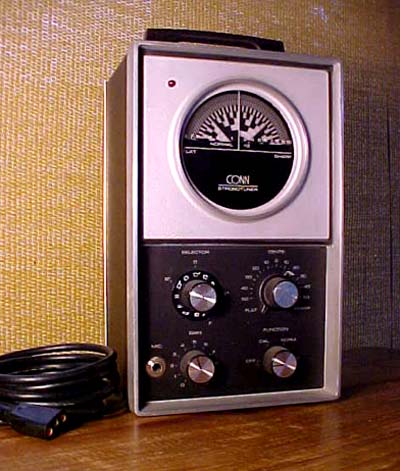
     When I first started playing in bands all the touring acts carried electronic stroboscopic tuners. Strobe tuners have been around since the 1930’s, and were primarily used by piano tuners.

    Conn Strobe Tuner
    Conn Strobe Tuner

    Although highly accurate, they were big, heavy, expensive, and sensitive to being knocked around in the back of a van.

    korg gt-6
    Korg GT-6 Tuner

    I was amazed when the Korg GT-6 portable guitar tuner first came out in 1979 – small, affordable and made specifically for guitarists. I ran to my local music store and bought one right away. Revolutionary!

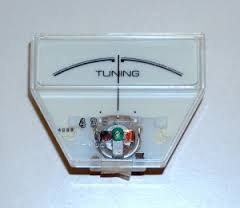
    Today, electronic battery-operated, hands-free guitar tuners are inexpensive, highly accurate, easy to use, and available at all music stores. You simply hold the microphone (built into the tuner) up close to the soundhole of an acoustic guitar, or plug an electric guitar directly into the device and then tune up by watching a meter with a needle (most accurate) or an LED display of some sort. Some tuners clip on to the headstock of your guitar and work by sensing the vibrations of the instrument. “Stomp box” foot pedal tuner designs are indispensable for electric players onstage.

    As with most things today, the amount you spend determines the quality of construction materials, durability, accuracy and flexibility of the tuner. Cheap tuners tend to break easily, or will go out of calibration if dropped. Pricier “chromatic” tuners will allow you to tune to any note, not just the six notes used in “standard” tuning, and are generally worth the extra cash. There are also tuning programs available as freeware on the internet.

    Although electronic tuners are amazing, you don’t want to become totally dependent on them. Almost all of the “old school” methods of tuning required a player to use their ears to listen to a reference pitch while attempting to match the tuning of their string to that reference. listen

    Listening is GOOD for you, and helps train your ear to minute changes in pitch.  It’s important to know exactly what to listen for. When two notes that are slightly out of tune with each other are played together, their combined frequencies produce an effect known as “destructive interference”. We hear this as a regularly occurring drop in the volume of the two notes, referred to as “beating”. Remember that it is the combination of two almost-in-tune notes that causes this effect – both pitches must be ringing in order to hear this beating effect.destructive

    The speed of the beating effect depends upon how close in frequency the notes being compared are. If the two notes played are very close in pitch, the beating will sound like a slow pulsing wave. If the notes are far apart in frequency, the beating will be rapid, producing a fast, warbling sound. Once a player can hear this, they begin to tighten or loosen a string, listening carefully to the speed of the beating until they are able to make the effect stop completely. When the two notes are perfectly in tune with each other the beating sound disappears. You are good to go!

    Let that be a lesson to you.  ;)

    If you liked it, please feel free to share my post with your friends.

    © 2014 Matthew Woodward


  • What’s In The Box?

    What’s In The Box?

    Over the years I’ve enjoyed collecting guitar-related accessories such as effects stomp pedals, cables, straps, cords, capos, stands, slides…and it’s still FUN.

    Years ago my onstage rig featured what was probably one of the first- ever “effects racks”, designed and built around 1980 by myself and my good friend, local electronic tech and Hammond B3 whiz Ken Hall, who was working at the back of Renaissance Music when they were on Princess Street. Ken and I were trying to come up with a way to get my pedals up off the floor so that I wasn’t kicking them around and unplugging them all the time, so we built them all into a 19″ rack about 2′ tall and then used a single pedal box at the front of the stage to control them all via relay switching.

    This is all stuff that’s taken for granted nowadays, but remember, back then we were like pioneers with this stuff! If I remember correctly, my guitar connected to the front-of-stage switch box via an XLR connection, so I couldn’t kick it out. This pedal controlled the on/off status of each effect, with green and red LEDs as indicators. We also added in/out loops on each side of the box, one for my wah pedal on the right, the other for whatever odd pedal I might be trying out at time. From there a multi-core cable led to the rack, and the signal chain went : tuner (with improvised kill switch for silent tuning – tuners didn’t have that option back then) -> Ashley SC-50 Peak Limiter/Compressor -> Boss Chorus -> MXR Distortion Plus -> MXR Flanger -> Yamaha E-1010 Analog Delay -> Roland RE-201 Space Echo -> A/B amp selector -> DOD Dual 15 Band EQ -> Marshall 50W and Fender Twin. The rack sat atop its Clydesdale road case beside me onstage.

    THE BOX

    IMG_6017

    Since those days I’ve stripped things down considerably and try to pack everything I need for a small club gig into an average sized suitcase, preferably of vintage. Many shows today have multiple bands playing and it’s important to be able to get set up and off the stage quickly, so here’s What’s In The Box:
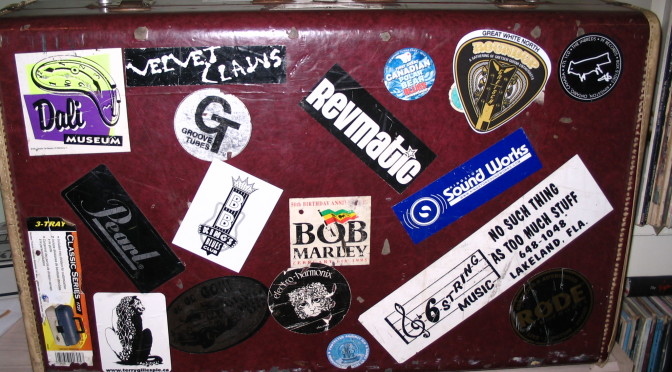
    IMG_6018You probably noticed how the suitcase is plastered with a bunch of decals. They’re so roadies know which side of the case should face up. First, a chunk of foam to protect my pedals and keep everything snug. The pedal board fits into the suitcase perfectly, with a little room left over to the side.

    Guitar Effects fx Pedal Board
    Guitar Effects fx Pedal Board

    I try to have things packed in the order in which I will need them as I setup, so the pedal board comes out first. Here’s what lays beneath:

    IMG_6023

    It looks messy, but it’s not, really. AC power cables are on top.

    IMG_6024IMG_6027

    Notice the orange thingy on the power bar. That’s a ground lifter. Illegal, as it omits the ground plug, but sometimes that’s the only way you can get rid of buzz & hum when using multiple amps.

    IMG_6025

    Next up are my patch cables that connect my guitar to the pedal board, and from that to my amplifier(s). Some long ones, medium sized and short jumpers. At the bottom of the pic is a speaker cable used for connecting a Marshall head to its cabinet.

    IMG_6026

    Finally, a collapsible guitar stand. That’s all I need to be setup.

    IMG_6028I do like to be prepared. The box also contains a really cool tool set from Canadian Tire – cost me $5.00 and has come in handy so many times, truly saving my ass in several dire situations.

    IMG_6021

    I’ve also got a little tin recipe box that I’ve had since about 1978. It contains fuses, 9V batteries, strings, pedal jumpers, capos, slides, etc.

    IMG_6022IMG_6030The Heineken thing is just something I rigged up on a sunny day to provide shade for my tuner so I could see the damned thing. Last but not least, a little screw-top Noxzema bottle to hold the little things:

    IMG_6034If you look closely, you’ll see $0.25 to use for emergency phone calls. That quarter has been with me forever. I know a payphone costs more now, but I just keep it in there for good luck.

    Wait! There’s more!

    Tucked into the side pouch, for making up set lists:

    IMG_6029And in the pouches on the lid, set lists and extra blank paper:

    IMG_6031IMG_6032

    So, that’s What’s In The Box. Hope you’ve enjoyed this little tour!

    Let that be a lesson to you.  ;)

    © 2014 Matthew Woodward

Verified by MonsterInsights